Ubuntu
Ubuntu (uu-BUUN-too) is a Linux distribution based on Debian and composed mostly of free and open-source software. Ubuntu is officially released in three editions: Desktop, Server, and Core for Internet of things devices and robots. All the editions can run on the computer alone, or in a virtual machine. Ubuntu is a popular operating system for cloud computing, with support for OpenStack. Ubuntu's default desktop has been GNOME, since version 17.10.

Ubuntu is released every six months, with long-term support (LTS) releases every two years. As of 22 April 2021, the most recent long-term support release is 20.04 ("Focal Fossa"), which is supported until 2025 under public support and until 2030 as a paid option for companies and free for individuals who register. The latest standard release is 21.10 ("Impish Indri"), which is supported for nine months.
Generally, developers and Tester prefer Ubuntu over Windows because it's very robust, secure and fast for programming.
Ubuntu is developed by British company Canonical, and a community of other developers, under a meritocratic governance model. Canonical provides security updates and support for each Ubuntu release, starting from the release date and until the release reaches its designated end-of-life (EOL) date. Canonical generates revenue through the sale of premium services related to Ubuntu and donations from those who download the Ubuntu software.
Ubuntu is named after the Nguni philosophy of ubuntu, which Canonical indicates means "humanity to others" with a connotation of "I am what I am because of who we all are".
Download link given below: https://releases.ubuntu.com/20.04/
Differences Between Linux vs Ubuntu
Linux is an open-source and free software operating system built around the Linux kernel and was first released by Linux Torvalds on September 17, 1991. A family of an operating system uses the name ‘Linux’ to emphasize that many Linux distributions share Linux kernel.
Ubuntu is an open-source and freely available operating system, one of the Linux distributions. There are several flavors of Ubuntu in markets like Ubuntu desktop for personal computing, Ubuntu Server for servers and Ubuntu core for a network of physical devices popularly known as the Internet of things (IoT).
Linux is a generic term which is a kernel and has several distributions, whereas Ubuntu is one of the Linux kernel-based distribution. Linux started its journey in 1991, whereas Ubuntu took off in 2004. ... Linux is based on the Linux kernel, whereas Ubuntu is based on the Linux system and is one project or distribution.
Linux usage is very high among servers; the majority of the web servers across the world run on Linux based operating system. Even though Windows and MAC like operating system are more popular than Linux for personal computing, but still Linux is steadily gaining popularity among the masses.
Ubuntu is based on the Linux kernel, and it is one of the Linux distributions, a project started by South African Mark Shuttle worth. Ubuntu is the most used type of Linux based operating system in desktop installations. Ubuntu provides a friendly operating system and stable enough, which is targeted toward the average computer user. It is easy to install, and simplicity is one of its key features.
Linux kernel is the core of the operating system, which is equivalent to an engine. Linux operating system is based on this kernel which Linus Torvalds crafted.
With its default installation, Ubuntu has a variety of software available like Firefox and several light games like chess and Sudoku.
Linux distributions include Fedora, Debian and so on. The most popular of all, when it comes to desktop installation, is Ubuntu. Linux gains some height during the 1990s because of developers who were basically a hobbyist. Although not user-friendly like windows and MAC, but it rarely crashes and reliable.
Ubuntu, like all Linux based operating system, has very few virus problems and, most of the time can be run without anti-virus software. Ubuntu requires specific privileges to install files, thus making it difficult for a virus to be loaded. This is the basic advantage provided by Ubuntu. Some of the versions of Linux, like Ubuntu, deactivate the file from the internet, which again helps block infections. Since an operating system like Ubuntu is an up-and-comer, writers with vile intentions are not yet spending enough time to target Ubuntu users.
Linux is open-source; thus, a majority of users can modify it, thus marking its range from phones to computers. User-friendly desktop environments, web browsers, and games helped increase Linux’s popularity and make it more suitable, comfortable for home desktops. Another attractive feature of Linux is flexibility. If I don’t like how something behaves, I can change it by replacing the piece of software that is compatible with my needs.
Head to Head Comparison Between Linux and Ubuntu (Infographics)
Below are the top 8 comparisons between Linux and Ubuntu:
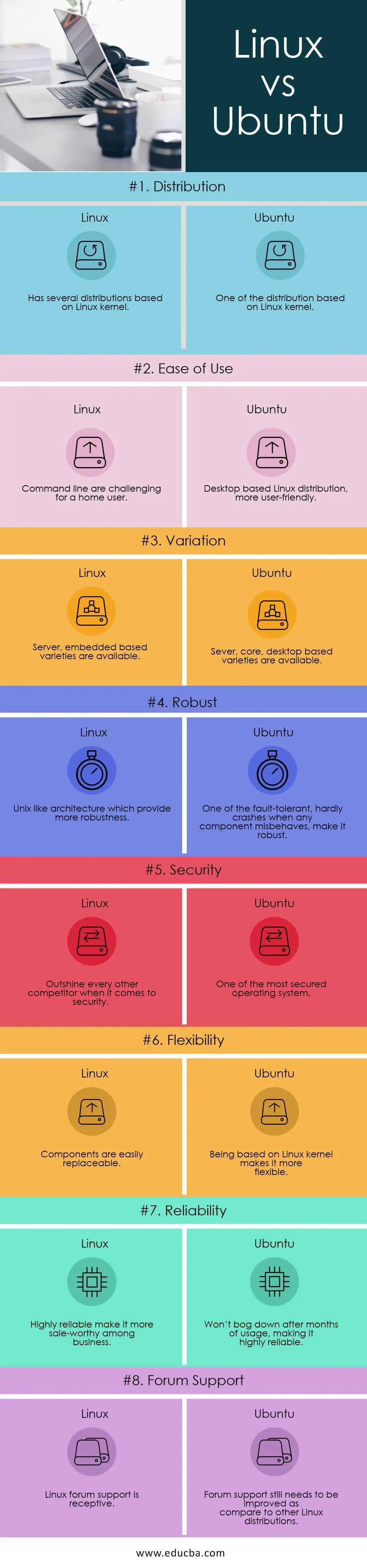
Key Differences Between Linux and Ubuntu
Below is the list of points that explain the key difference between Linux and Ubuntu:
- Linux is a generic term which is a kernel and has several distributions, whereas Ubuntu is one of the Linux kernel-based distribution.
- Linux started its journey in 1991, whereas Ubuntu took off in 2004.
- Linux was initially predominant among servers, making it hardly user-friendly among home and office users, whereas with the advent of Ubuntu, which was available on desktop computers, now becoming more receptive and friendly with home and office users.
- Several Linux distributions are available like Fedora, Suse, Debian and so on, whereas Ubuntu is one such desktop-based distribution based on Linux kernel.
- Linux is based on the Linux kernel, whereas Ubuntu is based on the Linux system and is one project or distribution.
- Linux is secure, and most of the Linux distributions do not need anti-virus to install, whereas Ubuntu, a desktop-based operating system, is super-secure among Linux distributions.
- Some of the Linux distributions are not desktop-based and dominant among servers, whereas Ubuntu is one of the desktop-based, is more user-friendly as compared to other Linux distribution.
- Linux commands follow the rules and procedure that the majority of the Linux based operating system follows, whereas Ubuntu does the same but has its own style and list of features.
- Navigation among Linux distribution can be quite a challenge for home and office users, whereas Ubuntu is easy and intuitive for the end-user.
- Installing a free server-based Linux distribution can be intimidating for an end-user, whereas Ubuntu is being carried out with easier follow-up guidelines than server-based distributions.
- Linux based operating system like Debian is not recommended for beginners, whereas Ubuntu is better for beginners.
Linux and Ubuntu Comparison Table
Following is the comparison table Between 8 Linux and Ubuntu.
| BASIS FOR COMPARISON | Linux | Ubuntu |
| Distribution | Have several distributions based on Linux kernel | One of the distribution based on the Linux kernel |
| Ease of Use | Command-line is challenging for a home user | Desktop-based Linux distribution, more user-friendly |
| Variation | Server, embedded based varieties are available | Sever, core, desktop-based varieties are available. |
| Robust | Unix like architecture which provides more robustness | One of the fault-tolerant hardly crashes when any component misbehaves, make it robust |
| Security | Outshine every other competitor when it comes to security | One of the most secure operating system |
| Flexibility | Components are easily replaceable | Being based on the Linux kernel makes it more flexible |
| Reliability | Highly reliable make it more sale-worthy among business | It won’t bog down after months of usage, making it highly reliable |
| Forum Support | Linux forum support is receptive | Forum support still needs to be improved as compared to other Linux distributions. |
Conclusion
Linux kernel is the heart of Ubuntu. It has Linux like architecture to interact with the computer’s hardware. Ubuntu commands also follow the same standard which standard Linux distribution follows, but at the same time, Ubuntu has its own set of standard and list of features.
Ubuntu is a graphical user interface (GUI) based operating system, making it the strongest competitor with the Windows and Mac operating system. On the top of the GUI, a security feature of Ubuntu is at par with other Linux distribution like Fedora, Debian etc. The reason for increasing awareness about Linux based operating system is mainly due to Ubuntu.
Linux has already been there for some time when Ubuntu was declared in 2004. Other Linux based distributions were pre-dominantly server-based and were not as user-friendly as Ubuntu, although sharing the same kernel. It was the first release of Ubuntu, making Linux reach far and wide among home and office users. Linux system can be installed in various computer hardware, smartphone, laptops and so on. Its usage is prevalent in servers. Although it may not match MAC and Windows’s popularity in the desktop market, it’s still gaining popularity in this region, thanks to Ubuntu like Linux distribution.


At APTRON Solutions, we believe in learning by doing. Our Linux Course in Noida provides ample opportunities for hands-on practice in a simulated environment. You'll work on real-world projects and assignments, allowing you to apply theoretical concepts to practical scenarios. Our experienced trainers offer personalized guidance and support, ensuring that you make the most out of your learning journey.
ReplyDeleteWe understand that everyone has different learning preferences and schedules. That's why we offer both classroom-based and online Linux Training Institute in Noida programs. You can choose the mode of learning that suits you best, without compromising on the quality of education.
ReplyDelete